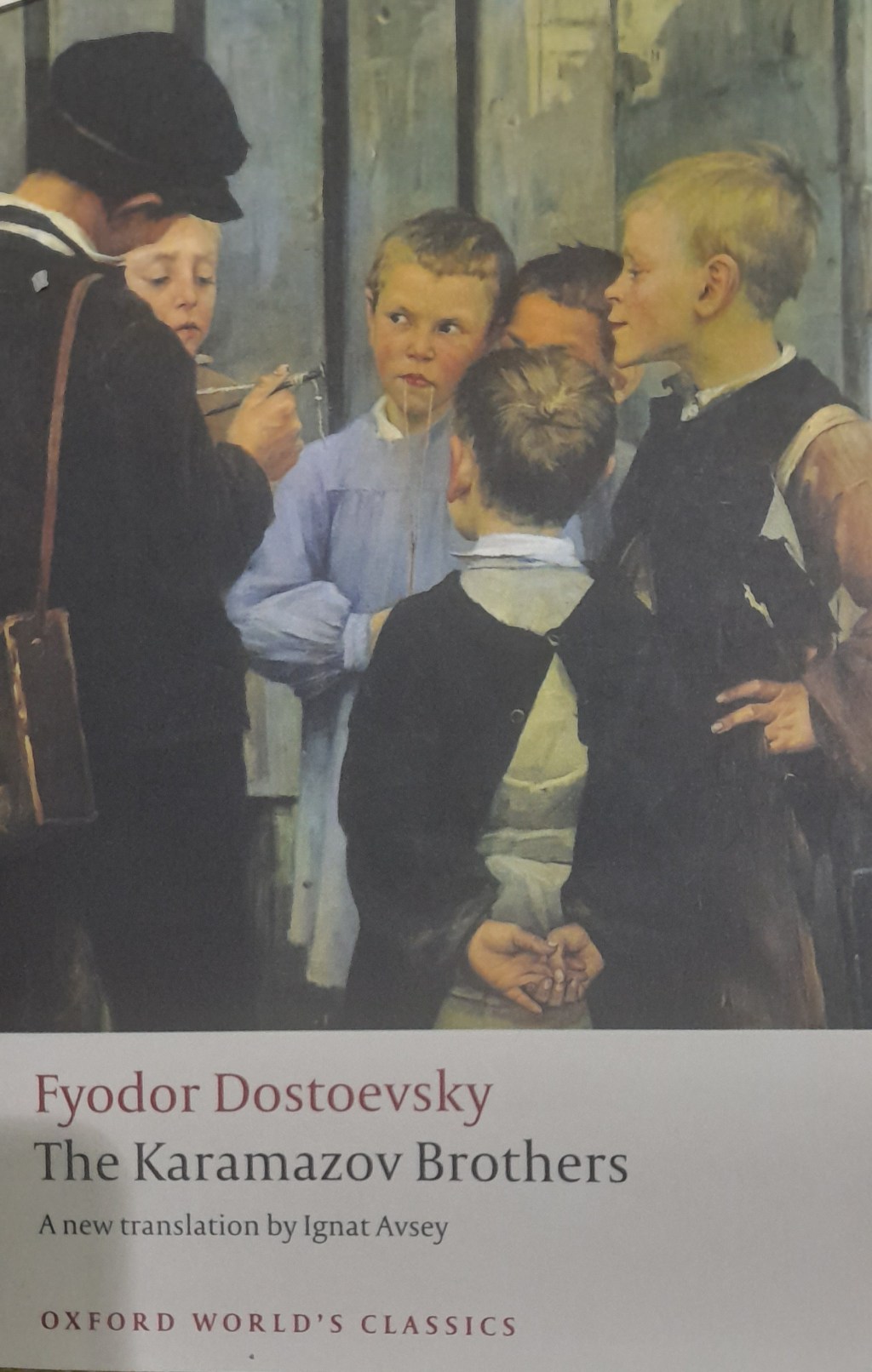
The sixteen-year-old me, who could barely read Jane Austen’s Mansfield Park for A’ Levels, would marvel at my comprehension of a dense book like The Karamazov Brothers by Fyodor Dostoevsky. I have since changed these past thirteen years. I do not confine my reading to only ‘African Literature’ (as I erstwhile proudly proclaimed to anyone who cared to ask). But I have developed a voracious appetite for World Literature, especially the Classics. World literature has afforded me deluxe learning experiences as I travel from country to country. I have just disembarked from my journey to Russia.
The Karamazov Brothers will be necessary reading for you if the problem of evil, the nature of suffering, the human condition, justice, the relationship between faith and reason, the battle of the isms, and the role of the Church in society happen to keep you up at night, as they seldom keep me. The book explores these questions at great length (my copy is about 900 pages long) and at great depth, but not in a textbook style. It is not a book on the need for world peace but a story. It is an exquisite psychological thriller and a delightful courtroom drama that tells a story of crime, love, family, faith, citizenship, madness, law and justice.
Sometimes, I had to pause because it seemed like the author wrote this book in 2024, not 1880. Some other times, all I did was snap my fingers at the sheer profundity of some statements. As such, I thought to share some noteworthy statements, hoping to pique your interest. Nonetheless, I must mention that my copy was translated by Ignat Avsey and published by Oxford University Press1. There are other translations and publishers, but reviews suggest that this translation is of a superior quality. Other translators translate the Russian original as ‘The Brothers Karamazov’. Avsey, however, deviates from the norm. That in itself is noteworthy. Here are the fifteen quotations.
“In most cases, people, even evil-doers, are much simpler and more naïve than we generally suppose. And the same is true of you and me.”
“For socialism is not only a question of the conditions of labour or of the so-called fourth estate, but rather, for the most part, a question of atheism, a question of today’s particular form of atheism; it is a Tower of Babel built specifically without God, not in order to ascend to heaven from earth, but in order to bring heaven down to earth.”
“Try to love your neighbours actively and steadfastly. The more you practise love, the more you will be convinced of the existence of God and the immortality of your soul. Should you attain total renunciation of self in your love for neighbour, then your faith will be absolute, and no doubt will ever assail your soul. This has been tried and tested.”
“’I’ve nothing much to say, except for one small point,’ Ivan Fyodorovich replied immediately, ‘and that is that European liberals in general, and even our Russian liberal dilettanti, frequently confuse the end results of socialism with those of Christianity, and have done so for a long time. This outlandish conclusion is, of course, very typical. As a matter of fact, it seems that it’s not only the liberals and dilettanti who confuse socialism with Christianity, but in many cases the forces of law and order do so too – foreign ones, of course.’”
“That secular science, having become a powerful force, has examined in detail, especially in this last century, everything divine bequeathed to us in the Holy Scriptures, but having subjected all that is holy to such rigorous analysis the scientists of the world have ended up empty handed. For in looking at the component parts in isolation they have quite overlooked the whole, and with a truly astounding lack of vision. But the whole stands inviolate before their eyes, as it always has done, and the gates of hell shall not prevail against it.”
“Let us suppose that I, for example, suffer deeply; now, another person cannot know how deeply I suffer, because he is another person and not me, and then on top of that it is rare for one person to recognise the suffering of another – as if it were a question of rank.”
“Of my parental home, I have only memories of the most precious kind, for there can be no memories more precious than those of early childhood in the parental home, and this is almost always the case even if there is little love and harmony in the family.”
“We have reached the stage at which we have surrounded ourselves with more things, but have less joy.”
“I have seen even ten-year-old children in factories, weak, sickly, worn out, and already degenerate. Airless sweatshops, noisy machinery, working all hours of the day, obscene language, and drink, nothing but drink – is that what the soul of a little child needs? He needs sunlight, children’s games, and to be set a good example in everything, as well as some love, be it ever so little.”
“Young man, do not neglect prayer. Each time you say your prayers, provided you are sincere, there will be a new spark of emotion and, along with it, a new idea, previously unknown to you, which will raise your spirits anew, and you will understand that prayer is education.”
“My friends, ask God for joy. Be as joyful as children, as the little birds in the sky. Do not let human sin confuse you in your mission, do not be afraid that it will stifle your endeavour and prevent it coming to fruition, do not say: ‘Sin is powerful, and we are lonely and helpless, we will be overwhelmed by this foul world, and it will not allow us to accomplish our virtuous endeavour.” P. 401
“Know the limits, know the times, learn to observe them.”
“Rakitin says you don’t need God to love mankind. Only a snotty pipsqueak could assert such a thing, it’s beyond me how he can say that.”
Usually in life, when one is faced with two opposites one must look for the truth somewhere in the middle.”
“But psychology, gentlemen, remarkable science though it may be, can nevertheless be all things to all men.”
- Avsey I., (1880) Fyodor Dostoevsky, The Karamazov Brothers, (Reprint, New York, Oxford University Press, 2008) pp. 12, 33, 71, 86-87, 215, 297, 363, 394, 395, 399, 401, 404, 744, 878, 914. ↩︎
 Joanna Bome Kure
Leave a comment