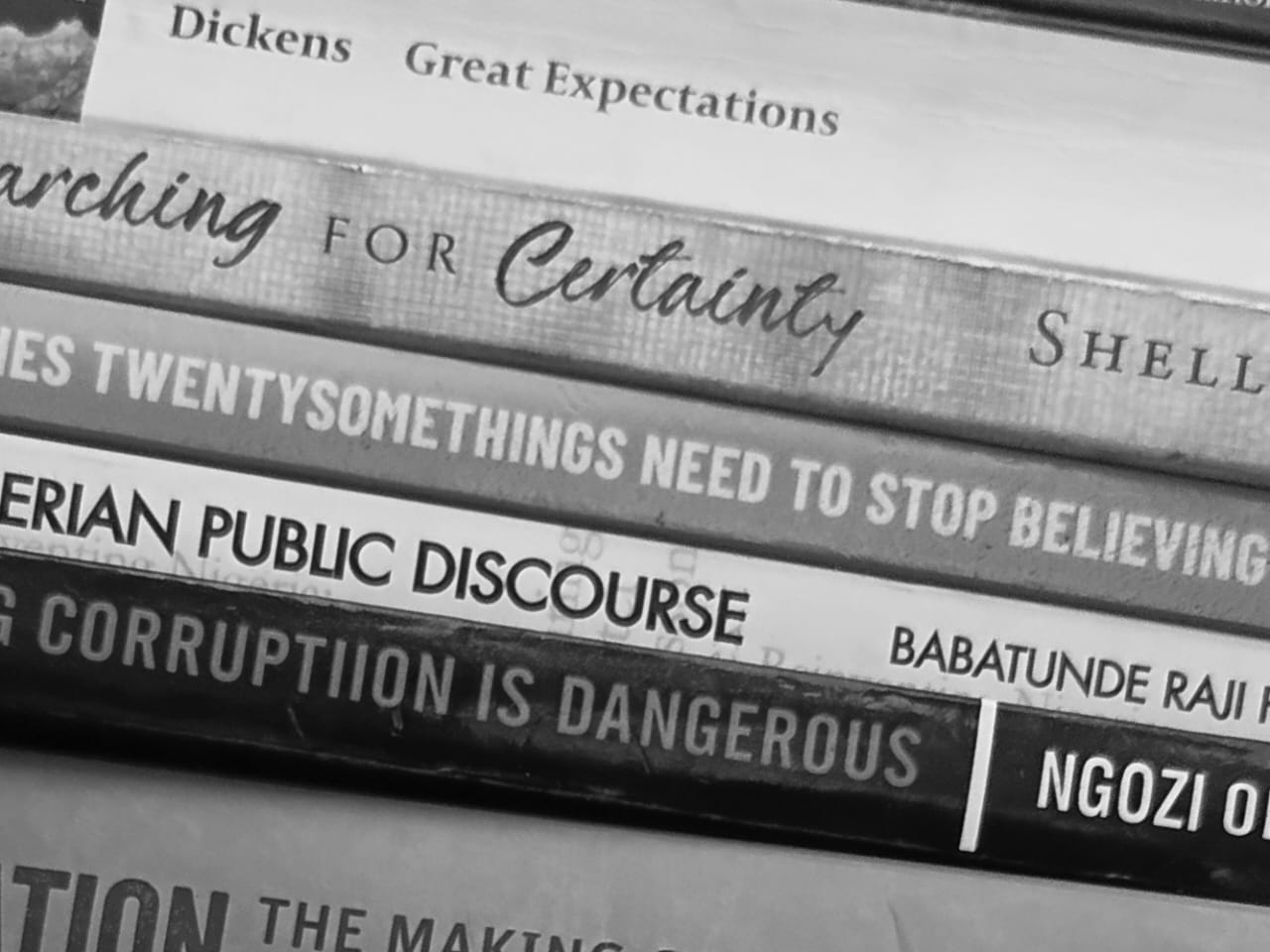
Fighting Corruption is Dangerous: The Story Behind the Headlines – Ngozi Okonjo-Iweala

“Some media in Nigeria, well ahead of the curve, were already purveyors of fake news and alternative facts before these became popular notions in 2017.” P. 21
Government is complicated business, but because talk is cheap, talkers claim government is not rocket science. Spoiler Alert! Government is rocket science, especially in a heterogeneous country like Nigeria. The more I read accounts from people who have served in government, the more I see how governance is as much about managing a plethora of interests as it is about policy formulation and execution. Interests range from foreign to local, media, civil society, legislature, opposition parties, citizens, etc. If one is not careful in managing these interests (or massaging these egos), one might implode from the pressure of running a functional government. This is what Ngozi Okonjo-Iweala writes about in Fighting Corruption is Dangerous: The Story Behind the Headlines. It is a glimpse of the politics of government: betrayals, surprises, media noise, politicisation of issues. As a public servant who has worked in two administrations since Nigeria’s return to democratic rule, Okonjo-Iweala is well-equipped to give an account of how dangerous it can be to try to do things right in Nigeria. I thoroughly enjoyed the straightforward prose, and liked that newspaper excerpts or factual reports were separated and formatted differently to preserve the narrative flow. In case anyone was ever in doubt, Fighting Corruption is Dangerous: The Story Behind the Headline adds to the evidence that in this clickbait era, headlines can be misleading. We need to question some of the stories we hear of people in power, especially when they intend to enrage us.
The Great Divorce – C. S. Lewis

The demand of the loveless and the self-imprisoned that they should be allowed to blackmail the universe: that till they consent to be happy (on their own terms) no one else shall taste joy: that theirs should be the final power; that Hell should be able to veto Heaven. p.135
On different occasions, two people mistook my reading The Great Divorce for preparation to divorce even before getting married. Talk about judging a book by its title! The Great Divorce is not about a broken marriage in human terms, but about the broken marriage between Christ and members of his bride, the Church. Thus, the book is more for believers than it is for unbelievers. It is a cautionary tale on the seemingly minute things that may keep one from entering Heaven. There is a tendency to think in grand terms of those sins that keep Heaven out of reach: idolatry, adultery, fornication, lying, stealing, but what about pride, unforgiveness, grumbling, apostasy or being judgmental?
Written as an allegory, with a host of characters, The Great Divorce is humorous, but not in a flippant way, with humour itself making certain points clearer. Yet there’s room for more than a chuckle. Some chapters left one feeling dismayed and full of pity, and at times, there was utter puzzlement. The story was largely easy to follow, and could be read in a day or two, depending on circumstances. It’s a good mirror to assess oneself and see those areas that could potentially keep one away from Heaven. I would recommend this book to be read and re-read throughout one’s Christian journey.
Nigerian Public Discourse: The Interplay of Empirical Evidence and Hyperbole – Babatunde Raji Fashola

This is essentially the crux of the matter: achieving a better union is not an event. It is an ongoing process that evolves from experience and can be continuously improved upon. P.77
It was in my first year at the University of Jos, studying Logic, that I learnt that the purpose of discourse (debate, argument) was not to win, but to reach an understanding or find common ground. Finding common ground has become imperative in our Babelian age where there is so much talk but little action to change things for the better because we cannot hear ourselves. The West is admired today because its people have, over time, agreed on certain ideals as fundamental, most of which were rooted in its Christian roots. Beyond that, the advent of Gutenberg’s press meant people could share ideas with wider audiences and critique others. This technology equipped Thomas Hobbes, Maximilien Robespierre, Thomas Paine, and Montesquieu to write treatises that still influence how we think about government and society. Funny how some of these ideals are being tested in the West again now that the West has turned on itself, slowly forgetting its values. But I digress.
Enter Babatunde Raji Fashola’s Nigerian Public Discourse: The Interplay of Empirical Evidence and Hyperbole where he discusses some of Nigeria’s national questions and presents his own solutions for consideration. The book’s purpose is to stimulate discourse; an invitation to find common ground and not to best one another in argument.
I have always admired Babatunde Raji Fashola, having grown up in Lagos under his leadership. Apart from the popular ‘Eko Oni Baje’ slogan attributed to him, I understood from the transformation of Lagos under his government the connection, for example, between taxes and a government that delivers. So, when I got the opportunity to purchase this book, I did not hesitate. I enjoyed the book and found that I agreed with him on many things, came to an understanding of certain things, while I respectfully kept in mind the things I did not agree with or understand. In Nigerian Public Discourse: The Interplay of Empirical Evidence and Hyperbole, Fashola discourses on corruption, out-of-school children, electricity, unfair comparisons, constitutional issues, minimum wage, duties and responsibilities of citizens, among others. I have accepted his invitation to discourse, and I hope the reader will too, to enliven and enrich our public square.
The Re-Write – Lizzie Damilola Blackburn

I only get one chance to be a debut, so if I’m going to publish a book, I want it to be about something that I’m passionate about, not a hastily written treatise about my ex. The Ultimate Payback was born out of anger. I want to spread love through my writing. Granted, I’m not crazy about Love Drive but who’s to say passion won’t come in time? P. 49
I bought this book because I thoroughly enjoyed Lizzie Damilola Blackburn’s Yinka Where is your Huzband? I would have to admit that Blackburn is a phenomenal writer, as her prose is easy to digest. Like most Nigerian fiction I read, I finished the book in less than a week. It is an interesting love story of a budding writer (Temi) and her celebrity ex (Wale). It is a story about second chances, healing and growth, set in London and told from a first-person point of view. It’s the sort of book that would do well on screen, and I think I have the perfect idea of who to cast as Temi, the protagonist. However, while I generally enjoyed the story, I did not expect the language to be profane at times. As such, Christian readers may want to exercise caution while reading the book.



Leave a Reply